

What is an assistance dog?
An assistance dog is specifically qualified to perform tasks that increase autonomy and mitigate limitations of a person with a disability. In contrast to dogs that may provide occasional support, assistance dogs live permanently and around the clock with their human. Their assistance increases autonomy, quality of life, and often safety through meaningful tasks, while the human handler provides leadership and care. Each successful partnership between human and dog is based on a balance of Give and Take.
Many people are familiar with guide dogs for the blind. However, there are many other types of assistance dogs who are no less important. The concept is rapidly expanding.
Qualified assistance dogs are carefully selected and receive intensive education, typically for over 21 months. Once the assistance dog team is ready, it should obtain a certification that establishes their status and access rights.
“Assistance Dog Welcome”
The access campaign “Assistance Dog Welcome” reached over 40 million people in Germany from 2018-21.
Assistance Dog Foundation is seeking partners to expand the campaign into many more countries.
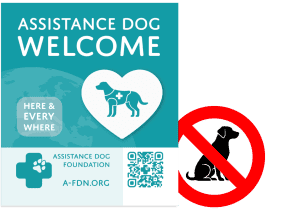
Access rights of assistance dog teams
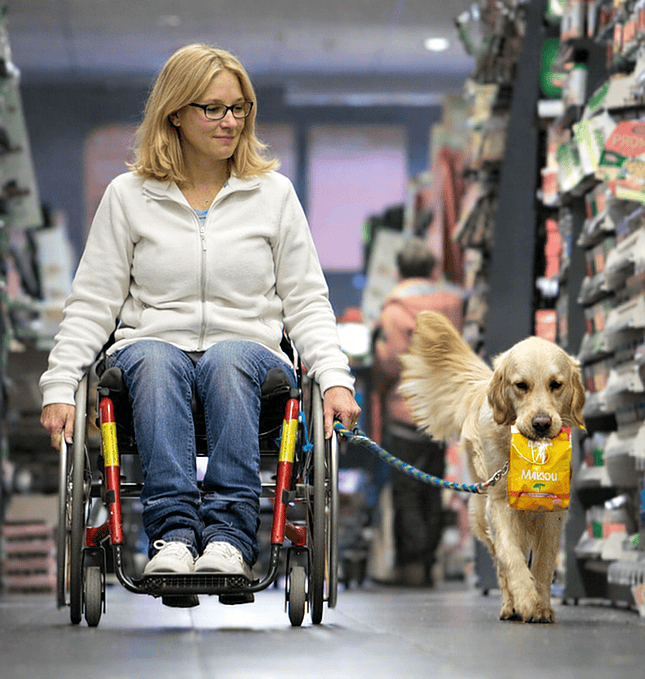
An assistance dog enables their human partner to participate in everyday life. That is why assistance dog teams have access rights wherever people in street clothes are allowed. This means that assistance dogs are also, among others, allowed in grocery stores, restaurants, cultural institutions, public transportation, and the medical sector.
The right to “animal assistance” is enshrined in international law (the UN Convention on the Rights of Persons with Disabilities—”UN CRPD”). Assistance dogs, therefore, have the right to access public places worldwide. A growing number of national laws support these access rights.
They are not mere companions; they are medical aids who mitigate the disabilities of their handler and provide them with autonomy. Only healthy, well-balanced, and reliable dogs succeed with the demanding training and pass independent certification. There is no reason to worry about assistance dogs causing problems.
How can I recognize assistance dogs?
Assistance dogs generally wear a harness, a vest, or a neckerchief while working.
Assistance Dog Foundation was founded to provide an independent, universal ID for qualified assistance dog teams based on ISO-aligned certification. Additional independent exams may also be reflected in our global register.
Currently, not all legitimate assistance dog teams have access to valid certification and their documentation therefore may be improvised. In addition, many disabilities are invisible, so it is unfair to assume that a person who does not “look disabled” is not having a legitimate reason to bring an assistance dog. In the current situation, please apply courtesy and give the team the benefit of the doubt. If the team does not act appropriately or the dog is drawing unwanted attention, you always have the right to limit access if it does not seem safe.
Please support us in ending improvisation and giving all legitimate assistance dog teams a clear and independent identification.


Correct behavior around assistance dog teams

Even if you have many questions and perhaps a dog treat in your pocket – please pay attention to these rules of conduct and safety instructions:
- Do not distract an assistance dog by stroking them without their human’s permission.
- Do not take a “No” personally. The dog may be working or needing rest – it is up to the handler to decide what is best for the dog.
- Do not stare at the team – this can be unpleasant for both dog and human!
- Do not speak to the dog and do not lure them.
- Do not feed the dog.

Make it easy for an assistance dog team to continue their day undisturbed and safely:
- Make sure you give them as much space as possible.
- Keep your distance with your dog when an assistance dog is working and/or on a leash.
- Please also keep your dog on a leash.
- It’s fine to talk to the person, but avoid personal questions like “Why do you have an assistance dog”?
Here are some of the common types of assistance dogs:
Visual impairment
guide around obstacles
Alert to both dangers and destinations
Hearing impairment
Display sounds
Warn of dangers
Retrieve lost items
Limited mobility
Retrieve objects
Operate doors/switches
Assist with undressing
Support balance
Epilepsy, narcolepsy, etc.
Alert to crises, get help
Retrieve medication
Protect and soothe
Post-Traumatic Stress Disorder (PTSD)
Interrupt crises
Awaken from nightmares
Relieve sensory overload
Autism/FASD
Relieve sensory overload
Support routines
Diabetes, allergies
Detect allergens
Alert to crises at an early stage

A young concept, rapidly expanding

